
A Fixed-Fee, Lawyer-Managed Divorce Process
An uncontested divorce in Ontario is a no-fault divorce proceeding under the federal Divorce Act in which both spouses agree on all issues, such as property division, spousal support, child support, and parenting arrangements, and neither party disputes the dissolution of the marriage. Most uncontested divorces are finalized in 4 to 6 months without a court appearance.
Uncontested divorces in Ontario are governed by the Divorce Act (Canada) and the Family Law Rules and are heard by the Ontario Superior Court of Justice. The application is filed using Form 8A, supported by Form 36 (Affidavit for Divorce) and a Draft Divorce Order (Form 25A).

Simple Divorce: Where one spouse applies, the other is served and does not oppose the application.
Joint Divorce: Where both spouses apply together as co-applicants.
Before a Divorce Order is granted you need to be separated for one year under s.8(2)(a) Divorce Act
Lived in Ontario for at least one year immediately before the application is filed under s.3(1) Divorce Act
If you have children, reasonable arrangements for their support must be in place in accordance with the Federal Child Support Guidelines.
You must have a legally valid marriage recognized under Canadian law
To file for a simple or joint divorce in Ontario, you must satisfy four mandatory legal requirements under the Divorce Act (Canada) and the Family Law Rules. Each requirement must be met at the time of filing or, in the case of the separation period, before the Divorce Order is granted.
The most common ground for divorce under s. 8(2)(a) of the Divorce Act requires living “separate and apart” for at least one full year.
Either you or your spouse must have been ordinarily resident in Ontario for at least one year immediately before the application is filed. This establishes the jurisdiction of the Ontario Superior Court of Justice under s. 3(1) of the Divorce Act.
Where children of the marriage are involved, the presiding judge has a statutory duty under s. 11(1)(b) of the Divorce Act to ensure their interests are protected before granting the divorce.
The marriage itself must be legally valid for the Ontario Superior Court of Justice to grant a divorce under s. 8(1) of the Divorce Act.
If your spouse disputes the divorce or you disagree on parenting, support, or property division, your matter is a contested divorce and follows a different court process. Contested matters require a tailored legal strategy rather than a flat-fee filing. Our family law team handles contested divorces, negotiations, and litigation across Ontario. Visit our Family Law page or call (905) 795-7757 for a consultation.
Before your divorce application can be issued by the Ontario Superior Court of Justice, you will need to gather the following documents. Having these ready at the outset avoids the most common cause of delay in uncontested divorce files.
1. Original Marriage Certificate
The court requires your original marriage certificate or a certified copy — not the decorative certificate issued at the ceremony. If you were married in Ontario, you can order a certified copy online from ServiceOntario. Standard processing takes approximately 15 business days; expedited options are available. If you were married in another province or country, you must obtain the certificate from the issuing authority in that jurisdiction.
2. Certified Translation (if applicable)
If your marriage certificate is not in English or French, it must be accompanied by a certified translation together with an affidavit sworn by the translator confirming the accuracy of the translation. Our office regularly arranges certified translations for clients married abroad.
3. Separation Agreement (if you have one)
A separation agreement is not mandatory for a divorce, but if one exists — particularly where it addresses child support, parenting arrangements, or spousal support — it should be provided, as the court may consider it when confirming that reasonable arrangements are in place for any children of the marriage.
4. Your Spouse’s Current Address
For a simple (sole) divorce application, your spouse must be personally served with the application. You will need their current residential address. If you do not know where your spouse lives, or your spouse is outside Canada, the divorce can still proceed. If serving a spouse who lives abroad or cannot be located, retain our lawyer to apply for substituted service.
5. Details of Prior Proceedings (if applicable)
If there are existing court orders or prior family law proceedings between you and your spouse, copies should be provided, as they must be disclosed in the application.
Missing your marriage certificate? We can guide you through the process of ordering a replacement before filing. Contact us or Start Your File Online.
| Features | Simple Divorce | Joint Divorce |
| Best For | Spouses who are non-responsive or non-cooperative, or living in different countries. | Amicable couples who want the fastest possible resolution. |
| Cooperation Level | Moderate. One spouse is willing to receive papers but doesn’t need to “do” the work. | High. Both spouses are active partners in the filing process. |
| Who signs? | Only Applicant signs | Both spouses sign the application |
| Court form | Form 8A – Application (Simple Divorce) | Form 8A – Application (Joint Divorce) |
| Service of documents | Required. The issued application must be served on the other spouse in accordance with the Family Law Rules | Not required. As both spouses apply jointly, service is not necessary |
| Risk | Spouse has 30 days to contest after being served. | Lowest risk of contest, as both parties agree upfront. |
IMPORTANT Both simple and joint divorce applications are considered uncontested only when there are no outstanding disputes regarding property, support, or parenting, and all statutory requirements under Ontario law are met. |
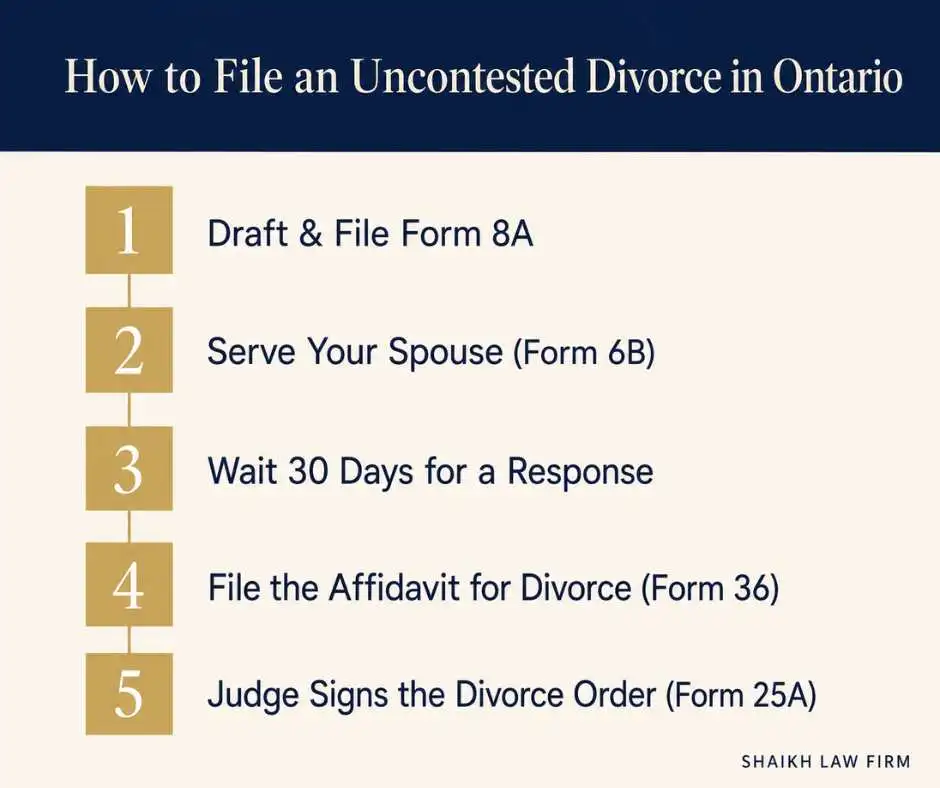
Navigating the Ontario Superior Court of Justice requires precision. Here is how the process unfolds when managed by our firm:
The process begins with Form 8A. We ensure all data, including the exact legal names and marriage details, matches your marriage certificate perfectly. Even a minor typo here can cause a court registrar to reject your application months later.
For a Simple Divorce, the court-issued papers must be “served” on your spouse by a third party.
Once served, your spouse has 30 calendar days to file an “Answer.” In an uncontested matter, this period usually passes without a response. This waiting period is mandatory under the Family Law Rules.
Once the 30 days have passed, we “set the matter down” for a judge. We prepare your Form 36 (Affidavit for Divorce), which serves as your “testimony.” This document confirms to the judge that the marriage has broken down and that all requirements, including child support, have been met.
We submit a Draft Divorce Order (Form 25A) to the judge. The judge reviews the entire file in chambers (no court appearance required). Once the judge signs the Order, the court mails a copy to both parties.
For a standard uncontested divorce in Ontario, Shaikh Law Firm charges a flat legal fee of $999 + HST. Ontario court filing fees of $669 are additional.
| Cost | Amount |
|---|---|
| Legal Fee | $999 + HST |
| Ontario Court Fees | $669 |
| Professional Process Server | If required |
| Translation or Other Third-Party Costs | If required |
The $999 + HST legal fee applies to a standard simple or joint uncontested divorce. Additional third-party costs generally arise only where required by the circumstances of the case.
For a detailed breakdown of lawyer fees, court fees and other potential expenses, see our complete guide to divorce costs in Ontario.
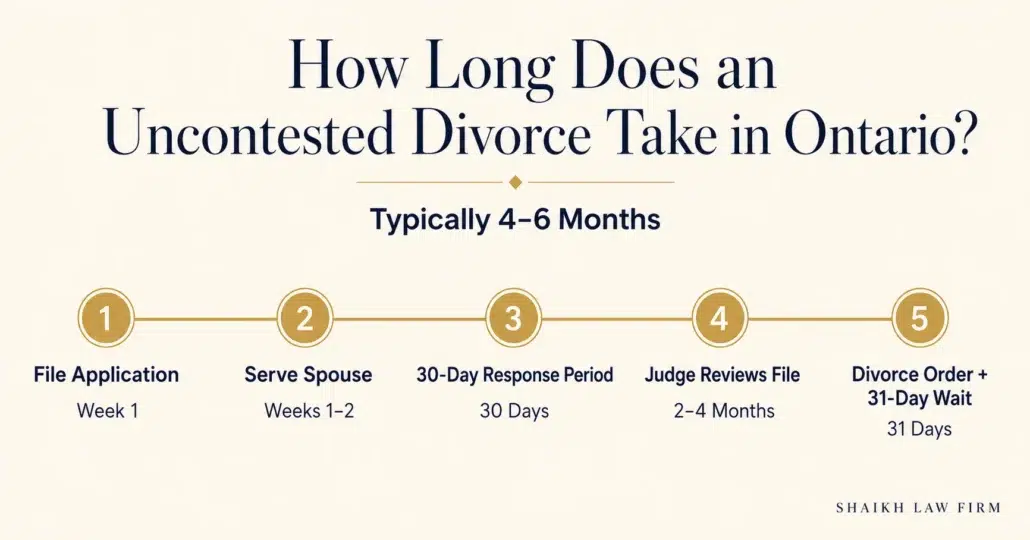
In 2026, an uncontested divorce in Ontario is typically finalized in 4 to 6 months from the date of filing. The process is governed by statutory timelines under the Divorce Act and the Family Law Rules, including a mandatory 30-day response period and a 31-day waiting period after the Divorce Order is signed. Joint divorces generally proceed faster than simple divorces, as the service and response requirements do not apply.
The standard uncontested divorce timeline in Ontario follows five distinct stages:
Step 1: File the Application — Week 1 Our firm drafts and files Form 8A with the Ontario Superior Court of Justice. The court issues the application, assigns a court file number, and returns the issued copy for service.
Step 2: Service or Joint Filing — Weeks 1–2 For a Simple Divorce, the issued application must be formally served on the other spouse by a third-party process server in accordance with the Family Law Rules. An Affidavit of Service (Form 6B) is then filed with the court. For a Joint Divorce, this step does not apply — both spouses file together as co-applicants.
Step 3: 30-Day Response Period — Approximately 30 Days Under the Family Law Rules, the served spouse has 30 calendar days from the date of service to file an Answer. In an uncontested matter, this period typically passes without response. This step does not apply to Joint Divorces.
Step 4: Court Review and Processing — 2 to 4 Months Once the response period has elapsed, our firm submits the Affidavit for Divorce (Form 36) and the Draft Divorce Order (Form 25A) to the Judge. The Judge reviews the file in chambers — no court appearance is required for either party. Processing times vary by court location.
Step 5: Divorce Order and Final 31-Day Wait — 31 Days Once the Judge signs the Divorce Order, it becomes legally effective 31 days later, pursuant to s. 12 of the Divorce Act. This waiting period is mandatory and cannot be waived except in rare circumstances.
Several factors may extend the standard 4 to 6 month timeline:
Joint divorces generally move faster because Steps 2 and 3 (service and the 30-day response period) are not required. A well-prepared Joint Divorce can be finalized in as little as 4 months, whereas a Simple Divorce typically takes 5 to 6 months from filing to final order.
| Phase | Description | Estimated Time |
| Phase 1: Filing | Draft and file Form 8A with the Ontario Superior Court of Justice | 1–2 Weeks |
| Phase 2: Service | Serve the spouse (Simple Divorce) or file jointly (Joint Divorce) | 1-2 Weeks |
| Phase 3: 30-day | Statutory waiting period for the spouse to file an Answer for Simple Divorce Only | 30 days |
| Phase 4: Review | Judge reviews Form 36 and Form 25A in chambers | 2-4 Months |
| Phase 5: Order | Mandatory 31-day wait under s. 12 of the Divorce Act | 31 days |
With over 30 years of combined experience in Ontario family law, our firm provides reliable, results-driven divorce representation grounded in professionalism, transparency, and care. We offer predictable, flat-fee pricing, personalized legal strategies, and a client-first approach designed to reduce stress while ensuring your matter is handled properly from start to finish.
Unlike automated or document-only services, our uncontested divorce process is fully lawyer-guided, legally compliant, and court-supervised. Your documents are prepared and reviewed by licensed Ontario lawyers, providing the assurance of professional oversight without the uncertainty or high hourly costs typically associated with traditional litigation-focused law firms.
Q: Do I need a separation agreement for an uncontested divorce in Ontario?
No, a separation agreement is not legally required to obtain an uncontested divorce in Ontario. However, it is strongly recommended to formalize issues such as property division, spousal support, child support, and parenting arrangements before filing. A properly drafted agreement prevents future disputes and confirms that all issues are resolved — a core requirement of any uncontested matter. For more information, see our guide on separation agreements in Ontario.
Q: What is the cheapest way to get a divorce in Ontario?
The most cost-effective way to get a divorce in Ontario is a Joint Uncontested Divorce. Because service is not required and both spouses file together, disbursement costs are minimized. At Shaikh Law Firm, our flat fee of $999 + HST covers a fully managed Simple or Joint uncontested divorce, bringing the total cost, including court fees, to approximately $1,797.87. For a detailed breakdown of low-cost options, see our guide on the cheapest way to get a divorce in Ontario.
Q: Can I file for an uncontested divorce online in Ontario?
Yes. The Ontario government offers an online divorce filing service for uncontested matters through the Ontario Superior Court of Justice. Our firm manages the online filing process on your behalf — preparing Form 8A, submitting supporting affidavits electronically, and coordinating with the court registry. This eliminates the need for in-person court visits. For more details, see our guide on online divorce in Ontario.
Q: What is the difference between a Divorce Order and a Divorce Certificate?
A Divorce Order is the signed judgment issued by the Ontario Superior Court of Justice that legally dissolves the marriage once the 31-day waiting period under s. 12 of the Divorce Act has elapsed. A Divorce Certificate is a separate, optional document issued by the court as formal proof that the divorce has taken effect. The Certificate costs $25 and is typically required only if you plan to remarry, apply for immigration, or require documentary proof of divorce for banking or foreign jurisdictions.
Q: Do I need a lawyer for an uncontested divorce in Ontario?
No, you are not legally required to retain a lawyer to file for an uncontested divorce in Ontario. However, retaining a family lawyer ensures that your application complies with the Divorce Act and the Family Law Rules, reduces the risk of court rejection due to procedural errors, and provides legal certainty on issues such as child support, property division, and spousal support. If you wish to proceed without legal representation, see our guide to do-it-yourself divorce in Ontario.
Q: When can I remarry after an uncontested divorce in Ontario?
You may legally remarry 31 days after the Judge signs your Divorce Order, which is the mandatory waiting period prescribed by s. 12 of the Divorce Act. To remarry, you will need to obtain a Divorce Certificate as proof that your previous marriage has been legally dissolved. The Certificate may be obtained from the Ontario Superior Court of Justice for a fee of $25.

(905) 795 7757
info@slclawyer.ca
(905) 795 1271
We serve clients across the province of Ontario and have multiple meeting locations.
Toronto | Mississauga | Brampton | Oakville | Milton |Hamilton | Kitchener & Waterloo | Scarborough | Barrie | Ottawa | Divorce lawyer Ontario